
Key takeaways
- A C&F agent stores and forwards a manufacturer's goods without taking ownership of the stock.
- The model helps brands enter regional markets faster without building and operating their own warehouse infrastructure.
- Reliable C&F operations depend on inventory visibility, category knowledge, written agreements and trained personnel.
Introduction
What is a C&F agent?
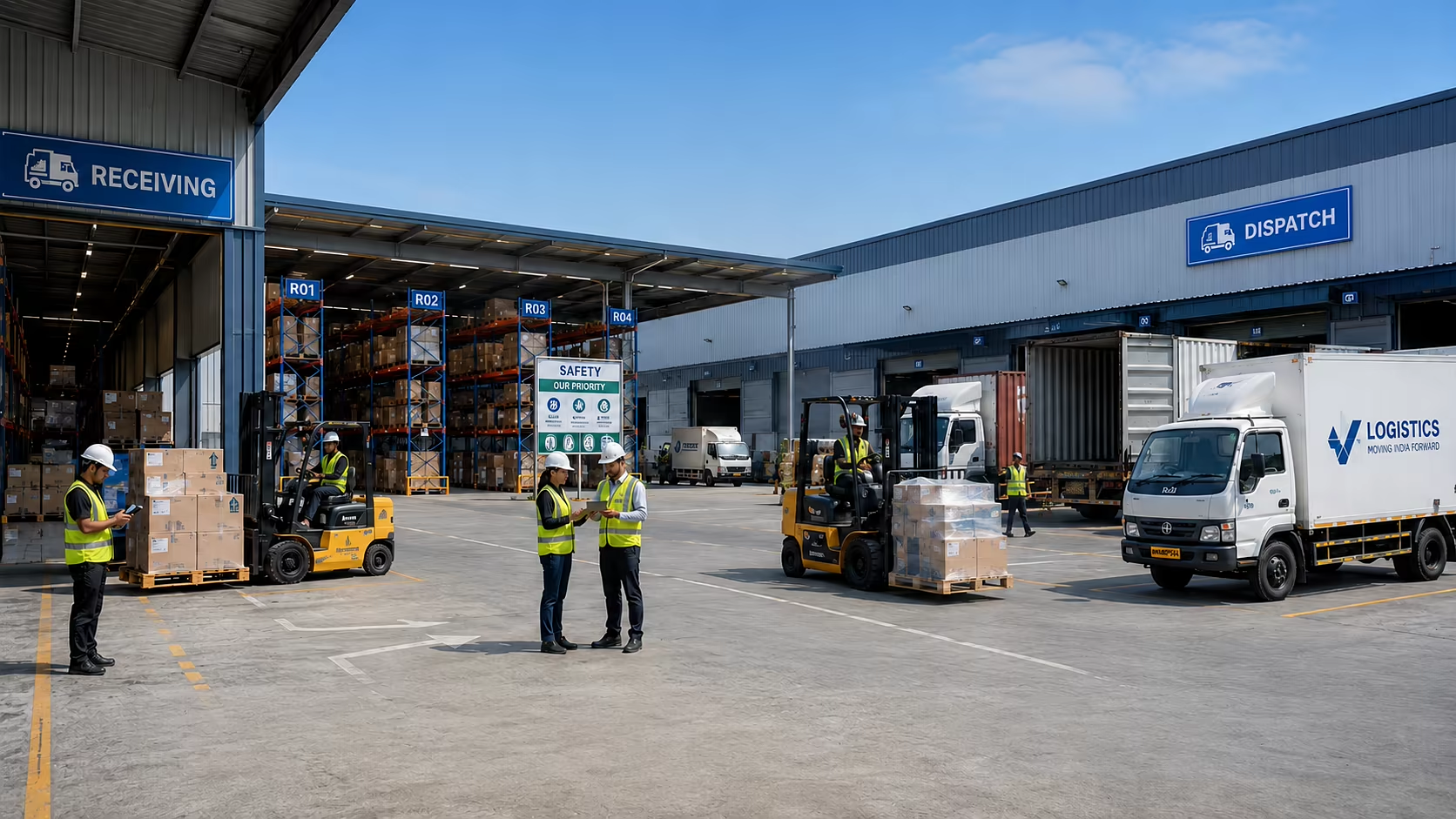
Walk into a regional distribution center in an area like Indore, Guwahati or Coimbatore and you are likely to be standing inside a setup run by a C&F agent, even if no one calls it that. Boxes of biscuits, shampoo packets, and strips of medicines are arranged on labeled racks, ready to be dispatched to several distributors by the next day. That stock does not belong to the person managing the warehouse.
So, who are C&F agents? In simple terms, C&F agents are businesses that store, move and supply goods of a manufacturer within a specific geographical region without owning the goods in question. The manufacturers keep the ownership and pricing rights and C&F agents get paid for providing services like storage, receiving and distributing orders, thereby playing an all-important but hidden role in making sure that a national brand reaches small shops within a matter of days after its launch.
Operating model
How the principal-to-agent model works
The Carrying and Forwarding Agent is an entity that works on a principal-to-agent model, not on the basis of buyer-seller. The brand sends its bulk stock to the warehouse of the agent; the agent keeps the stock, processes the orders, and forwards the goods to the distributors on behalf of the brand. The ownership is never transferred to the agent. This is what differentiates the role of the agent from that of a distributor or a super stockist, who buy the stock and take the risk of selling it. The agent is usually paid a fixed monthly fee, a commission on either dispatch or sale of the product, or a combination of the two but never a margin, and it is a common occurrence in FMCG, pharma, cosmetics, sweets, and cold-chain categories like frozen food.
Important distinction
Carrying and forwarding is different from customs clearing
One important thing to clarify is that in the field of import-export, the above abbreviation can refer to a Clearing and Forwarding Agent that is involved in the preparation of customs documentation at ports, which is a function performed by Customs House Agents (CHAs). When the same term is used in the context of domestic FMCG and pharma distribution, however, it invariably refers to Carrying and Forwarding, and it is this definition that will be used in this guide.
There are three roles that often jar with each other. One is the distributor or super stockist who buys the inventory upfront, possesses it, and sells at a profit on behalf of the manufacturer while risking unsold goods in stock. The second player is C&F agent who does not own the inventory but gets paid for its storage and transportation. The last entity is the CHA that is engaged in customs clearance, documentation, and port clearance for the shipments. Hence there is no overlap when it comes to domestic storage.
Market expansion
Why brands rely on C&F agents
Imagine a mid-sized pharmaceutical company making its entry in Delhi NCR. Constructing a regulatory compliant warehouse would probably require a good deal of time, close to a year even, while hiring an agent already operating in the area allows one to enter the market in weeks, thus avoiding payment on developing an infrastructure.
Operational flow
How a C&F operation moves goods
The model consists of two connected operational phases:
- 01
Primary distribution
In this phase, bulk cargo is transported from the manufacturing site to a regional storage facility.
- 02
Receiving and tracking
In this phase, items are counted, and other important information is documented in the batch documentation.
- 03
Order processing
At this stage, orders are made by the distributors in the region through the sales representatives of the brand.
- 04
Invoicing
Invoices are created and shipment instructions are generated.
- 05
Secondary distribution
At this phase, smaller consignments are being dispatched within a planned schedule.
- 06
Inventory reporting
In this stage, stock levels and sales data are shared back to the brand in order to finalize the next shipment.
This two-phase hand-off system illustrates how a product can be delivered to a shop placed hundreds of kilometers away from the nearest metro station within a few days.
Business value
Benefits of the C&F model
The system provides a true solution to the issue of territorial speed of reach without having to own or control the entire territory. The main benefits of this scheme are fast arrival to the market without establishing owned infrastructure piece by piece, reduced fixed costs, increased flexibility since rent and pay turns into variable costs depending on the volume of business provided by the scheme, and development opportunities because adding or leaving any territory is easier than establishing or closing one's own warehouse.
Operating standards
What makes a trustworthy C&F operator?
What makes trustworthy operators stand out from non-reputable ones are the following practices: having real-time visibility on stocks via ERP instead of relying on manual registers; having knowledge about the corresponding category, i.e. using cold-chain handling and control for frozen food items; having written agreements on commission and liability in case of stock damage; and starting operations from a single location before going national.
Industry outlook
How India's distribution backbone is changing
India's FMCG sector remains one of the largest consumer markets in the world, and its distribution backbone is shifting fast:
- Quick commerce is compressing replenishment cycles, with dark-store operators expecting stock top-ups within hours rather than the weekly cycles general trade was built around.
- Technology is no longer optional — operators still running on paper registers are losing accounts to system-driven, ERP-integrated ones.
- Specialisation earns a premium, since compliant cold-chain capacity for dairy, frozen food, and pharma stays scarce in many Indian markets.
- Tier-2 and tier-3 reach still wins business, as general trade continues to move the bulk of FMCG volume outside metros.
Learning how inventory, transport and distribution connect is also central to broader logistics and supply chain operations.
Operational realities
Challenges involved in managing a C&F operation
Managing the operation involves more than the availability of space:
- Seasonal spikes in demand. As seen with the food items, souvenir and various fast-moving consumer goods (FMCG), activity around festival time brings on big swings, so the agents who lack agility in terms of warehouse and manpower will struggle in terms of costs as well as high chances of missing a dispatch.
- Difficulties regarding damages and expired products. The problem here is that in food and pharmaceutical companies there are cases of disagreements over absorbing the losses for spoiled or expired products by companies; that is why even though the concept of written compensation conditions is much better than verbal understanding.
- Cash-flow problems. There is a cash gap between sending goods and receiving payments, which is shortlisted by taking into an account the cycles of payments.
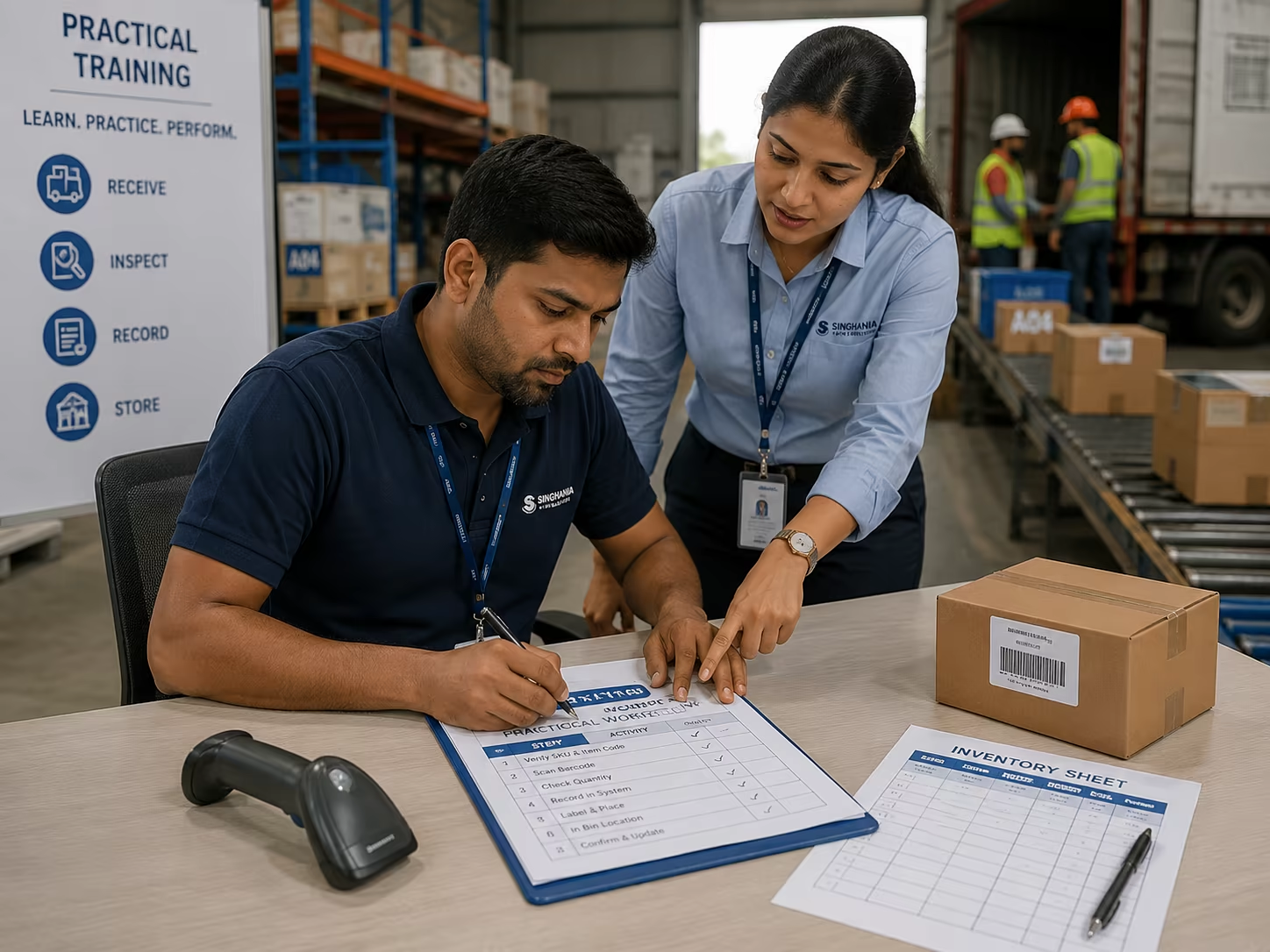
- Competent people. There should be properly trained personnel who understand how to keep proper records in the warehouse.
Common questions
Frequently asked questions about CFA training
Is a C&F agent the same as a distributor?
No, that is incorrect. A distributor physically acquires and owns goods before selling them, while a C&F agent never owns them but is engaged for the charge of storing and transporting the goods on behalf of the brand.
Is a domestic C&F agent the same as a Clearing and Forwarding Agent or CHA?
No, that is incorrect. A clearing and forwarding agent (CHA) manages customs clearance for goods arriving in India, while the domestic role of warehousing and distribution throughout India has no connection to customs.
How much investment is required and how does a C&F agent earn?
Investment amounts may vary significantly depending on the brand, city, and product mix. The warehouse size, deposit, and labor can differ from shipment to shipment. Earnings are usually based on the percentage of shipments and sales, set service charges, or various combinations of these two schemes.
Which industries commonly use C&F agents?
FMCG, pharma, cosmetics, confectionery, and cold-chain product categories such as frozen foods and dairy which require quick regional penetration.
Can a C&F agent work with multiple brands?
Yes, many companies do, but some brands prefer or require exclusivity in a certain category or region for the sake of avoiding stock-holding confusion.
Conclusion
Why the C&F agent model remains relevant
A C&F agent can be explained in very simple terms as one who operates as a warehouse in a region, where the brand managing the operation does not have to set up its own facility — instead, the C&F agent holds onto the products and manages their delivery. Understanding the concept of a C&F agent is crucial to any brand planning its market entry into a particular state, or, for that matter, to anyone like an entrepreneur who wants to tie up with the agent to help conduct business.
The reason why the C&F agent concept remains relevant is the solution it brings to the problem of getting the products to the market without incurring the expense of a costly infrastructure. Any such operating agent will exhibit the same traits and conduct lots of similar business activities which includes having and maintaining an optimal level of visibility with respect to the stock, ensuring that written arrangements for commissions and claims are in place and possessing the knowledge of the particular industry of the products being developed.
Continue learning
Explore CFA Operations & Management
Build structured operational understanding through guided modules, practical activities, assessments and instructor support.