
Key takeaways
- A career in logistics India has now become diversified, including jobs in technology and data analytics, warehouse automation and supply chain.
- Think of logistics careers as a ladder, not a single job title.
- You don't need an MBA to start a career in logistics India, but you do need specific, practical skills.
Industry overview
A career in logistics India today
If you had asked someone ten years ago what they think about a career in logistics in India, they would see a truck driver or a warehouse worker performing hard work with no thanks in return. But it is no longer how things are. A career in logistics India has now become diversified, including jobs in technology and data analytics, warehouse automation and supply chain. It is one of the few sectors with demand outpacing supply of skilled professionals.
Each item you buy online, every drug delivered to a drugstore in a remote location, and every shirt sold in a retail store goes through a whole process doing so. There is someone who sets up this route, organizes the warehouse process, and brings goods to a destination. This person is in great demand nowadays, and this guide will reveal how the industry functions nowadays.
The logistics field in India comprises planning and organizing everything connected with supply, transport, warehousing, and delivery of goods at the input level (i.e. when raw materials arrive at the plant) and at the output level (i.e. when the final product is delivered to the client). Logistics is one of the functions of supply chain management, but it relates mostly to the physical and operational side of the problem, such as transport, warehousing, stock levels, and paperwork.
Career options
Roles in the logistics industry
Roles in this space generally fall into a few buckets:
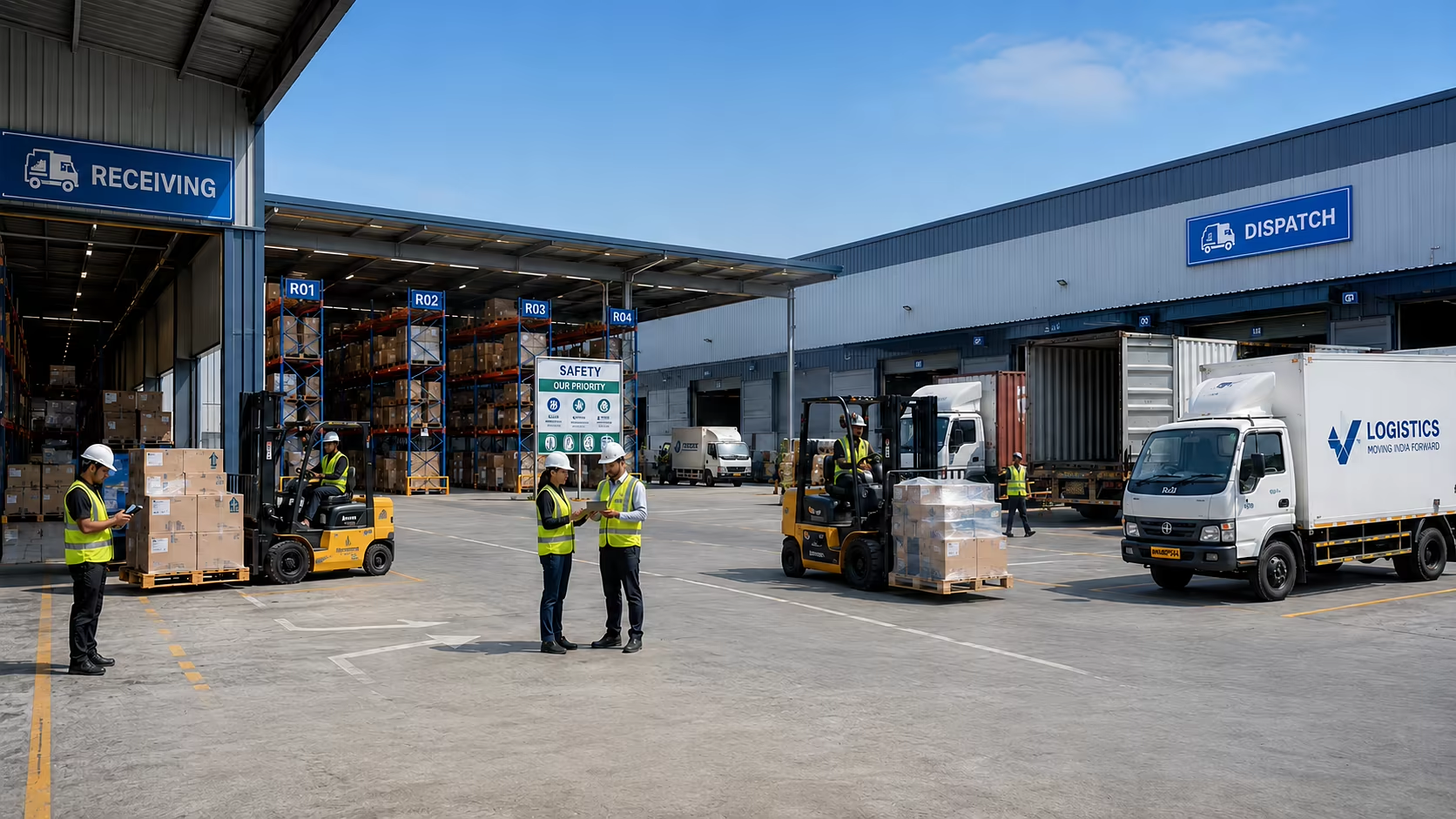
- Warehousing and inventory — receiving, storage, stock accuracy, dispatch
- Transportation and freight — route planning, fleet management, vendor coordination
- Carrying and Forwarding (C&F/CFA) — the link between manufacturers, distributors, and retailers
- Documentation and compliance — invoices, e-way bills, customs and import-export paperwork
- Technology-driven roles — warehouse management systems (WMS), data analysis, tracking platforms
The importance of these categories should not be underestimated as most of those who join the profession are unaware of the great number of options open to them aside from just “driving a truck” or “loading a van.”
Industry growth
Why logistics careers are growing in India
This is not merely a conjecture since it is backed by data. The logistics industry in India reached a valuation of nearly $215 billion in 2021, growing at an average rate of more than 10% annually due to the implementation of policies such as the National Logistics Policy, GST, and PM GatiShakti for development of infrastructure. As per government statistics, there are over 22 million people employed in the industry today and the number is expected to grow in the next few years due to the expansion of e-commerce, production, and cold chain distribution.
Around 13-14% of India’s GDP is the share of logistics in India, and as the government makes efforts to reduce this to international levels, that means that the logistics industry will surely need more companies to become more self-organised, employ more professionals in formal positions, and have more career opportunities available in the industry. Thus, when it is also revealed to a graduate or working person who wants to change their job, it looks very unlikely that anywhere else there will be a combination of rapid growth, serious demand for specialists, and low barriers to entry.
Career path
Career progression in logistics
Think of logistics careers as a ladder, not a single job title. A typical progression looks like this:
- 01
Entry-level operations
Warehouse Executive, Dispatch Executive, Order Processing Executive
- 02
Supervisory roles
Warehouse Supervisor, Stores In-charge, Logistics Coordinator
- 03
Mid-management
Warehouse Manager, Depot/Stockist Manager, Transport or Fleet Manager
- 04
Specialised or senior roles
Supply Chain Analyst, 3PL Operations Manager, Cold Storage Manager, Distribution Manager
Let's take a simple example: an individual graduated in commerce is hired as an Order Processing Executive in a distribution company. After spending a couple of years working as an operator and gaining valuable experience in receiving shipments, conducting inventory checks, and planning dispatches, that same operator may qualify for a supervisory position since in logistics, hands-on experience is as valuable as the diploma.
The function of Carrying and Forwarding (CFA) is the first step towards a preferred position in the industry. CFA professionals hold a unique position in the distribution chain and act as a bridge between manufacturers, warehouses, and retailers, thus allowing them to understand the various aspects of the supply chain process.
Job readiness
Practical skills employers look for
You don't need an MBA to start a career in logistics India, but you do need specific, practical skills. Employers consistently look for:
- Inventory and warehouse management — stock control, audits, storage systems
- Documentation knowledge — invoices, e-way bills, GST compliance, import-export paperwork
- Basic software literacy — Warehouse Management Systems (WMS), barcode and RFID tools, Excel
- Communication and coordination — since the job constantly involves vendors, clients, and internal teams
- Problem-solving under pressure — shipments get delayed, stock counts go wrong, and someone has to fix it fast
The fact is that getting your degree does not guarantee that you will have the necessary skills and knowledge to be able to work in a warehouse. Short logistics courses have recently become popular. These logistics courses focus on practical experience and are not just theoretical. Numerous institutions offer CFA, warehousing, and logistics courses, which ensure that people get necessary practical experience in performing warehousing processes such as receiving, picking, packing, and dispatching, as well as receive required knowledge in relation to how to comply with legal requirements. The duration of these courses usually varies and does not exceed three months.
Future outlook
Industry shifts worth watching
A few shifts are worth watching if you're planning your entry point:
- Growth of e-commerce and quick commerce has resulted in increased demand for fulfillment center managers, last-mile delivery executives and specialists in warehouse automation.
- Cold-chain logistics may have developed its needs due to the pharmaceutical, dairy and frozen food industries, but it also greatly relies on people trained specifically to handle temperature-sensitive goods.
- Digitisation with the help of platforms such as Unified Logistics Interface Platform (ULIP) has forced companies to increasingly hire people who know how to work with tracking technology and utilize real-time data rather than simply relying on manual tracking systems.
- The formalization of the informal sector means more companies start hiring permanently employed professionals instead of hiring just hourly workers for their companies — which is excellent news for those looking for a long-term career in this sector.
Career preparation
Common gaps and how to address them
Most people don't fail in logistics because they lack potential. They struggle because of a few recurring gaps:
- “I have a degree but no practical exposure.” Fix: Give preference to practical training as opposed to theory-based classes. Warehouses tend to hire only those candidates who understand how the shipment process functions.
- “I don't know which role suits me.” Fix: Consider taking a short-duration operations-oriented course before investing your time into the educational process. This will help you determine if you like warehouse operations, supply chain control, or paperwork work.
- “Interviews ask about software I've never used.” Fix: Try to learn the most basic WMS and inventory tools before sending your application. Even a little hands-on experience may increase your chances.
- “I don't know how to explain my project work.” Fix: Training programmes that give certificates of experience or project completion provide you with something tangible in the interviews.
Common questions
Frequently asked questions about CFA training
Is a career in logistics India a good option for freshers?
Yes. It is among the few industries recruiting at scale with specific entry points and no need for an expensive degree; real-life skills and knowledge play a greater role than paper degrees.
What qualifications do I need to start?
Many basic logistics jobs and entry-level warehousing jobs accept recent graduates, undergraduates, and even a person switching careers if they have certain job-related training and/or CFA education.
How much can I earn in logistics in India?
Entry-level positions generally start low and simple, but positions of supervisor and manager, especially in warehousing, CFA, and transport, may experience rapid increase of pay in two or three years after hiring.
Is logistics only about driving or manual work?
Not at all. It comprises the documentation, inventory evaluation, software-led warehousing, and coordinating roles, most of which require little or no manual work.
Which cities offer the most logistics job opportunities?
The states like Delhi NCR, Mumbai, Bengaluru, Pune and Chennai serve as major logistics operational centers as a result of manufacturing, e-commerce warehousing, and distribution networks.
Do I need to know English fluently to work in logistics?
Basic formal language is useful, especially when it comes to coordination roles, but most job positions in warehousing and operations believe in practical know-how rather than communication skills.
What's the fastest way to get job-ready?
A short, actionable logistics or CFA course with practical warehouse experience often lasts two to three months and allows students to receive targeted training faster than a standard degree program.
Conclusion
Why a career in logistics India is a solid career choice
A career in logistics India has stopped being a last-resort option and has turned into a truly solid career choice due to the two-digit sector growth, millions of current vacancies available and the increasing skill gap that gives an advantage to educated practitioners rather than mere theorists. No matter if you are a school leaver, a working individual considering the change, or a person who is making your first serious career step, you have to understand the career direction clearly: know the opportunities available, learn to work practically with documents in warehouses, learn the latest technologies in automation and e-commerce, and get the appropriate training.
Continue learning
Explore Logistics & Supply Chain Management
Build structured operational understanding through guided modules, practical activities, assessments and instructor support.